Showing posts with label usgs. Show all posts

Sunday, 28 February 2010

Chile earthquake

By now you will no doubt have heard about the 8.8 earthquake that hit central Chile yesterday, triggering tsunami warnings in 53 countries around the Pacific. There are lots of news reports, and there are location maps and more details from the BGS, USGS and Pacific Tsunami Warning Center.

This map from the BBC shows the tsunami spreading across the Pacific Ocean:


The Boston Globe Big Picture, as ever, has some amazing images.

Wednesday, 13 January 2010

Earthquake in Haiti

Awful situation in Haiti at the moment as a result of a M7 earthquake - the worst in the area for 200 years - that struck the capital, Port-au-Prince, last night.

Haiti is one of the world's poorest countries, with many people living in poorly constructed slum dwellings. The death toll is already thought to be in the thousands, and the Red Cross estimate that up to three million people have been affected. The lack of infrastructure is a major issue, and the absence of ambulances, fire engines and emergency rescue teams is noticeable in the images that are appearing on the various news websites.

Emergency response teams from various countries including the UK, together with aid agencies such as Oxfam and ActionAid are preparing to fly out to Haiti, and the UN have released £6 million from their emergency relief fund to help the victims of the earthquake.

BBC
CNN
Sky News

Monday, 6 April 2009

Earthquake in Italy and Chilean volcano

I was reminded when I switched the news on this morning of my A Level Geography teacher, who used to say that every time he taught plate tectonics, he could almost guarantee there'd be an earthquake or a volcanic eruption somewhere in the world. That's certainly seemed to be the case every time I've taught it, and just the other day I told Yr13 to watch the news over the holidays.

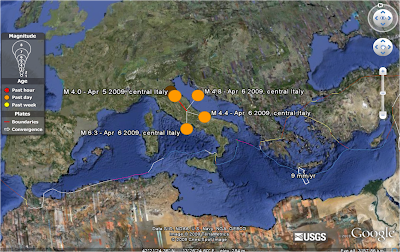
Sadly, the first news item I saw this morning was that an earthquake in Italy had killed at least 16 people. According to the BBC website, the death toll is now 27. The magnitude 6.3 earthquake struck the medieval city of L'Aquila in the early hours of this morning, causing many of the city's 70,000 residents to run out into the streets in panic. The age of the buildings meant that many of them were unable to withstand the quake, and the narrow mountainous roads are making rescue attempts more difficult.

The Google Earth screenshot below shows the area, with the USGS earthquakes layer enabled.
More from the BBC here.

Also on the same news bulletin was that the Llaima volcano in Chile has been "spewing lava, ash and gas" overnight, causing many people from the surrounding area to be evacuated. As well as the danger from the eruption itself, melting snow is increasing the risk of mudslides, and volcanic ash has caused river levels in the area to increase. More here.

Saturday, 8 November 2008

ShakeOut!

How would you cope if a magnitude 7.8 earthquake struck? Very unlikely in Swanwick, but a real possibility for people living near the San Andreas Fault... which is why, on 13th November, more than 5 million people in Southern California will be taking part in The Great Southern Californian Shakeout - "the largest earthquake preparedness activity in US history".

Have a look at this video which shows what could happen when "the big one" strikes, and check out the ShakeOut website where there is lots more information, more video clips, and you can test your earthquake preparedness by playing Beat the Quake.


Thanks to Bob and Alan...

Wednesday, 29 October 2008

Earthquake in Pakistan

It seems that whenever we are studying tectonics, there is an earthquake or a volcanic eruption somewhere in the world. Unfortunately, this time is no exception...

An earthquake measuring 6.4 on the Richter Scale struck 35 miles from Quetta in the Balochistan province of Pakistan this morning at 4am. So far, the death toll is 160, but this is expected to rise.

The USGS has details here including a Google Map showing the location, and you can find out more from the BBC where there is a set of eyewitness accounts, an In Pictures series, and some video footage.